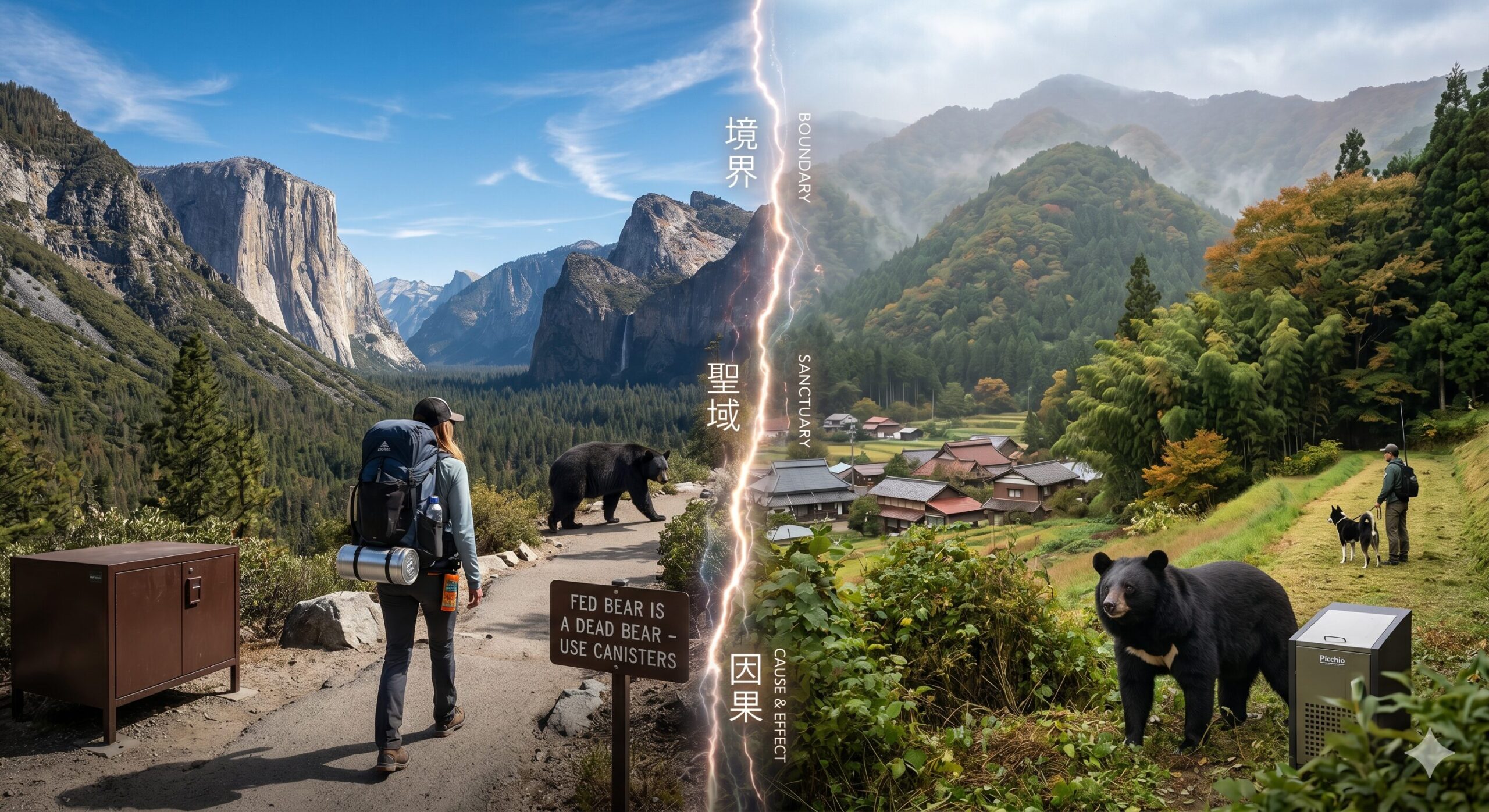
Nature and the mountains are always honest.
They do not cater to human convenience or emotional arguments; they simply move according to the laws of existence. What is currently happening on the boundary between the mountains and human settlements in Japan feels like a calm, cold query posed by this “honesty of the mountains” to human society.
- What I Learned in the Sierra Nevada
- Asiatic Black Bears and American Black Bears: Different Destinies of the Same Lineage
- The Tragedy Born from Japan’s Half-Hearted Measures
- Bear Spray as the Resolve to Live in Reality
- What Karuizawa’s “Picchio” Demonstrates
- The Domino Effect of Ecosystem Collapse Caused by Over-Culling Bears
- The Question Posed by the Mountains
What I Learned in the Sierra Nevada
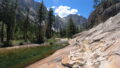
Having lived in the United States for a long time, I repeatedly went on multi-day backpacking trips into the Sierra Nevada and the Rocky Mountains. I visited areas stretching from Yosemite to Sequoia & Kings Canyon and the Mount Whitney area multiple times, and bear encounters occurred regularly.
However, even when we talk about an “encounter,” in most cases, the bear noticed me first and quietly vanished into the woods. They inherently live to avoid humans. As long as you do not panic, a black bear is nothing more than a “wild neighbor” coexisting in the same space.
Yet, the management system in places like Yosemite National Park is terrifyingly thorough in maintaining this “peaceful relationship.”
At campsites, leaving any food inside your vehicle is strictly forbidden. Backpackers are legally required to carry bear canisters (hard-sided animal-resistant food containers), and we were educated never to bring even a single tube of toothpaste inside our tents. If a bear attracted by an odor gets even a single “success experience” of obtaining human food, that individual undergoes a fundamental transformation.
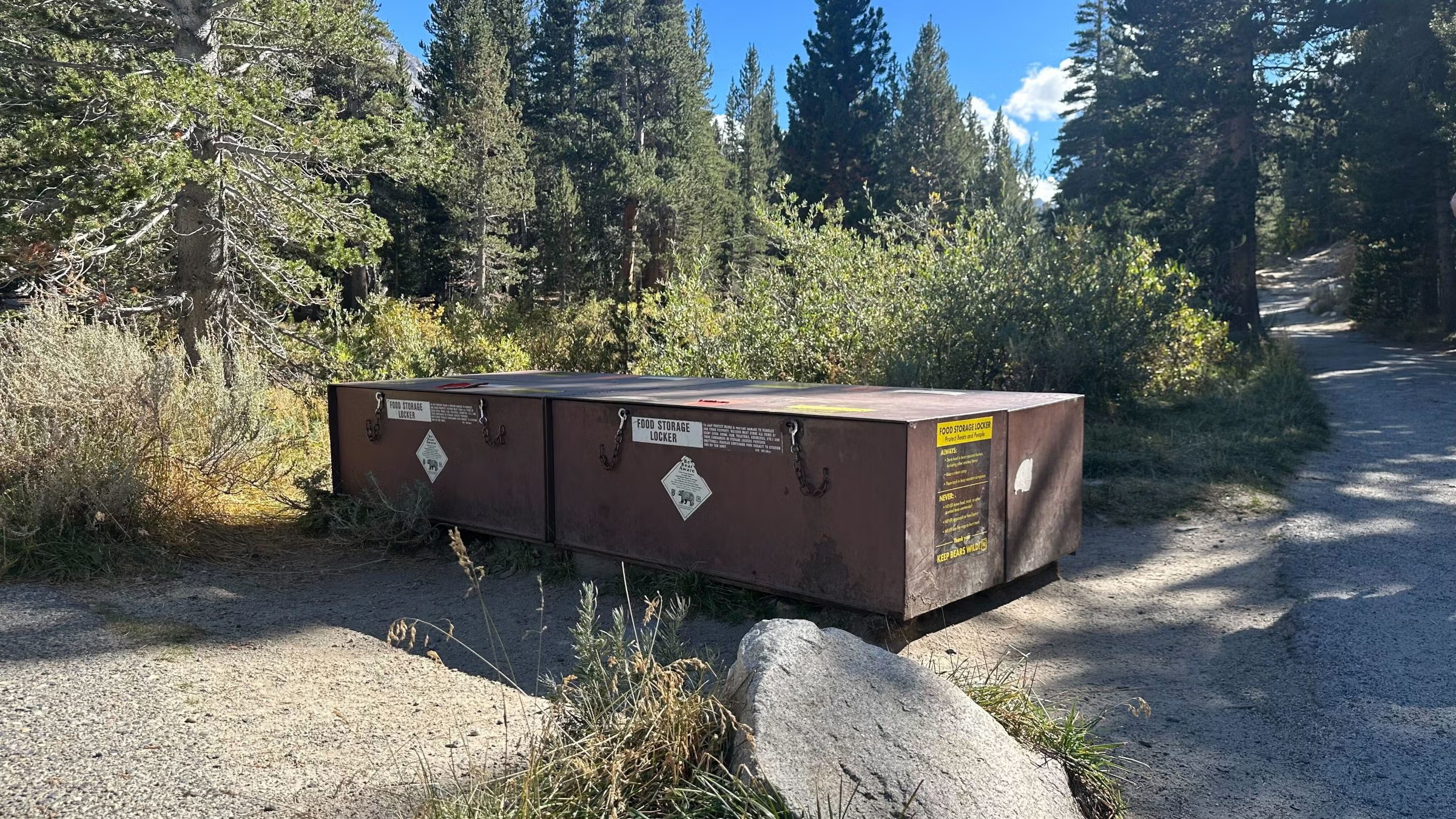

Fed bear is a dead bear
“A fed bear is a dead bear.”——This is the ironclad rule that Yosemite National Park drills into every single visitor.
A bear that has learned the taste of human food is deemed dangerous, and its behavioral shift is considered irreversible, ultimately leading to euthanasia. This seemingly cruel rule is, in reality, a system designed to protect the bear species as a whole. The management side thoroughly integrates a powerful behavioral principle—”Do not approach human food”—into the entire infrastructure.
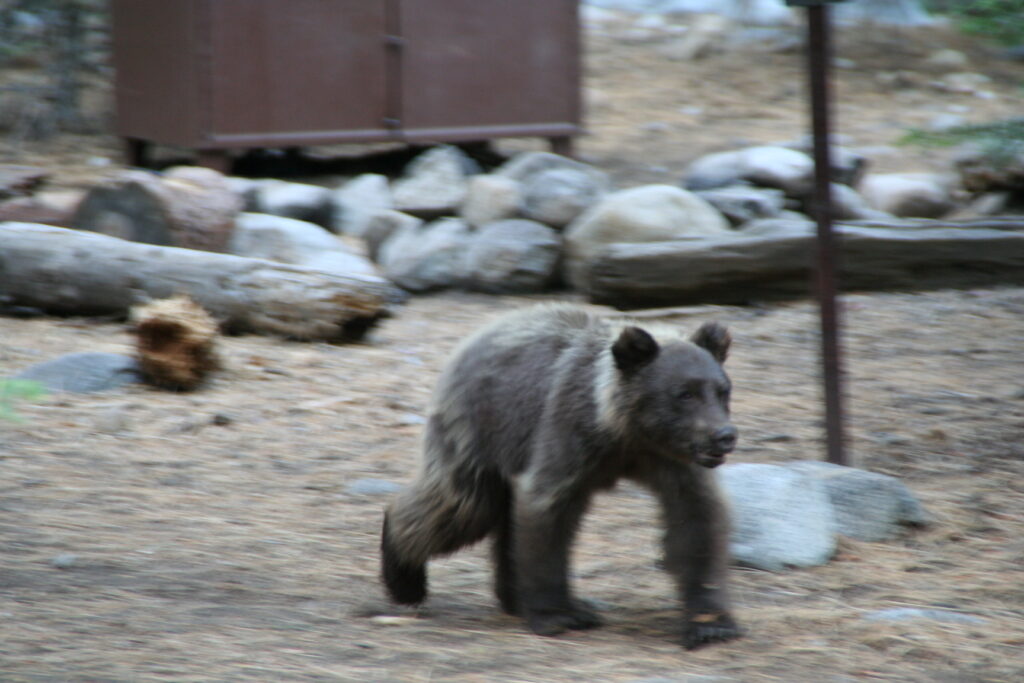
Asiatic Black Bears and American Black Bears: Different Destinies of the Same Lineage
The Japanese Asiatic black bear and the American black bear are closely related species belonging to the same Ursidae family, sharing similar ecological baselines. They are fundamentally timid, primarily herbivorous, and possess an inherent fear of humans.
In the past, in the mountain villages of Japan, the Asiatic black bear was indeed considered a “gentle resident of the mountains.” Living deep in the peaks, they maintained an appropriate distance from humans, observing an unwritten, invisible boundary that neither side crossed.
So, what changed? From my perspective, it wasn’t the bears that changed, but rather the management and resolve on the human side.
The Dissolution of “Satoyama” as a Buffer Zone
In the past, Japan’s mountainous and semi-mountainous regions possessed “Satoyama.” These were semi-natural spaces dynamically shaped by daily human presence—where people cut firewood, mowed grass, and gathered brushwood. Bears instinctively avoided these areas. Well-cleared with high visibility and saturated with the scent of human activity, Satoyama functioned as a strict “forbidden buffer zone” for the timid Asiatic black bears.
However, depopulation and aging intensified, leading to the decline of agriculture and forestry. The land left behind by humans reverted into dense, overgrown brush and wilderness. For the bears, this thick brush transformed into a “green corridor,” allowing them to slip deep into human settlements completely unseen.
Simultaneously, the number of hunters plummeted. The opportunity for young bears to inherit the collective memory from their parents that “humans are terrifying entities” was lost. This “new generation of bears” stopped recognizing humans as objects to be feared or avoided.
In a spiritual sense, this signifies the “collapse of the boundary.” The invisible barrier that once existed between humans and nature has been quietly dissolved by the absolute absence of human presence.
Climate Change as a “Great Fluctuation”
Furthermore, climate change has accelerated this shift.
The survival strategy of the Asiatic black bear depends heavily on a cycle of consuming massive amounts of acorns from beech and oak trees in autumn to build up body fat before entering hibernation. In recent years, however, global warming and extreme weather patterns have severely disrupted the fruiting cycles of these broad-leaved trees, causing widespread, synchronized crop failures across vast regions.
When there are no acorns in the mountains, the bears come down. Is it really that simple?
The fact that this phenomenon has led to over 50,000 sightings and 238 human casualties in a single fiscal year (FY2025) serves as clear evidence of a structural crisis that cannot be dismissed as a mere natural anomaly. Disruption in hibernation cycles has exacerbated the situation, giving rise to “Anamotazu” (non-hibernating bears) wandering into cities during seasons when they should logically be asleep beneath the snow.
The Tragedy Born from Japan’s Half-Hearted Measures
At backcountry campsites in the Japanese Northern Alps, there have been incidents where bears have collapsed tents with sleeping occupants inside, or where unattended tents have been slashed and raked for food. According to news reports, after such a bear was captured, it was relocated and released deep into another mountain area.
When I heard this news, frankly, I was astonished.
Under the Yosemite school of management thought, a bear that has consumed human food even once is already a dangerous individual, and its behavioral alteration is viewed as completely irreversible. The response is euthanasia, not relocation. This is not out of cruelty, but for the structural consistency of the system.
While Japan’s policy of relocation may stem from humanistic compassion, science shows that the homing instinct of the Asiatic black bear is exceptionally powerful. Unless they are released at least 12 kilometers away from the capture point, they will almost certainly return to their original location. Moreover, the fragmented, mosaic topography of mainland Japan means that no matter where you release a bear, it will inevitably fall within 12 kilometers of someone else’s living sphere. This does not solve the problem; it can be seen as merely pushing the risk onto a neighboring community.
This half-hearted response, suspended precariously between emotional sentiment and systematic management, may be actively generating a chain of further incidents.
Bear Spray as the Resolve to Live in Reality
I carried bear spray even in the Sierra Nevada, an area known to be inhabited exclusively by black bears. In places like Montana or Wyoming, where grizzlies roam, carrying bear spray is mandated by law.
Today, bear spray can be seen on shelves everywhere across Japan. Given the parade of bear scares, it is perhaps an inevitable shift. However, simply possessing the tool is not enough. In Japan’s steep, precipitous ravines, the roaring sound of rushing rivers frequently drowns out the sound of bear bells, rendering acoustic deterrents entirely useless. Hikers must cultivate a “mountain intelligence”—the capacity to read the terrain and combine multiple, sophisticated countermeasures according to the situation.
What Karuizawa’s “Picchio” Demonstrates
Amidst these challenging conditions on the mainland, a project serves as an exceptional benchmark: the wildlife management initiative led by the NPO “Picchio” in Karuizawa, Nagano Prefecture. While they have successfully presented an advanced co-existence model, they are currently entering a new phase due to the overwhelming shifts in the environment.
1. Picchio’s Four Core Approaches to Bear Management
Picchio’s defining characteristic lies in its avoidance of blind culling, choosing instead to scientifically and behaviorally redraw the “appropriate boundary” between humans and wildlife.
- Monitoring via Radio Transmitters: Captured bears are anesthetized and fitted with collar-type radio transmitters. The behavioral patterns and risk levels of each individual are tracked and digitized, allowing handlers to detect early signs of encroachment into human zones and implement pre-emptive deterrence.
- Deterrence via Japan’s First “Bear Dogs”: In 2004, Picchio imported Karelian Bear Dogs from a specialized institution in the United States. Under the precise guidance of handlers, these dogs drive bears deep back into the forest through intense barking without inflicting physical harm. This conditions the wild spirit of the bear to remember human zones as spaces of fear.
- Complete Elimination of Attractants (Wildlife-Proof Garbage Cans): To sever the bear’s attachment to human garbage (high-energy food), Picchio independently developed a specialized, heavy-duty garbage box (Bear Smart Box) that cannot be breached by a bear’s brute strength or claws. Its widespread adoption across the town has effectively reduced garbage-related incidents to zero.
- The “Aversive Learning and Release” System: Instead of simply letting captured bears loose into the mountains, they are subjected to intense negative stimuli—such as human shouts, barking dogs, and rubber bullets—at the exact moment of release. This instills a profound aversion to human presence before returning them to the wild.
2. The 2026 Shift: Temporary Suspension of “Learning-Release” due to Social Conditions
However, according to the latest announcements released by Picchio, a temporary restriction has been placed on this management protocol by the town of Karuizawa, driven by the intensifying severity of bear damages nationwide and the resulting public anxiety.
- Freezing Releases in the Buffer Zone: For individuals captured within the “buffer zone”—the matrix situated precisely between the forest and residential areas—a temporary measure was enacted to completely halt all aversive learning-and-release protocols, regardless of whether the specific bear displayed problematic behavior.
- The Background of Friction and Anxiety: This is a pragmatic defensive measure reflecting a shift toward stricter zoning or more definitive culling protocols. It is designed to alleviate the acute anxiety of local residents following multiple attacks across the country, while also considering the psychological and physical impacts on neighboring municipalities if a released bear were to migrate.
3. Picchio’s Future Strategic Pivot
With the option of release partially restricted, Picchio is currently shifting its resources away from post-capture processing and concentrating on “containment prior to crossing the boundary.”
- Environmental Upgrades of the Buffer Zone: Thorough clearing of brush and removal of potential attractants are conducted to transform the perimeter of human settlements into a space of high visibility—an environment that is inherently exposure-prone, difficult to hide in, and deeply uncomfortable for a bear.
- Amplifying Pre-emptive Deterrence: The moment transmitter data indicates a bear is approaching the buffer zone, handlers deploy Bear Dogs to pre-emptively drive the animal back into the deep woods, preventing any contact or friction with human society before it can manifest.
Insight: How Should We Maintain Our Distance from the Wild?
The fact that even an advanced, humane co-existence model like Picchio’s “Learning-Release” has been forced to adapt demonstrates just how thoroughly our conventional, half-hearted zoning has reached its absolute limit in the face of today’s overwhelming wildlife reality.
This issue cannot be resolved through a simplistic binary of “kill them because they are dangerous” versus “save them because it is pitiful.” What is required now of municipalities across Japan is a profound, unyielding resolve to redraw the boundaries of human space.
The Domino Effect of Ecosystem Collapse Caused by Over-Culling Bears
“Humans create the root causes, yet we slaughter the bears that emerge because they are dangerous—and through that culling, we distort the balance of nature even further.” This anxiety regarding an endless, vicious cycle is powerfully articulated among wildlife experts.
Why is the total elimination of bears so perilous? The answer lies in the immense, structural role bears fulfill within the forest ecosystem.
First and foremost, the bear is an “umbrella species” occupying the apex of the ecosystem. Its absolute presence acts as a massive protective canopy that safeguards the biodiversity of the entire forest matrix.
Furthermore, bears are critical “seed dispersers (the landscape architects of the forest).” They consume massive quantities of acorns and wild fruits, transport them across vast distances, and deposit them alongside nutrient-rich waste, ensuring the continuity of plant life. Without bears, the generational succession of the forest structure stalls.
If humanity over-culls bears out of short-sighted fear, what awaits us is a domino-like collapse of the ecosystem. Stripped of their natural checks, populations of deer and wild boars will explode, decimating forest vegetation and causing the mountains to dry out and degrade.
The essential question we must confront is not merely “how to eliminate the bear in front of us,” but rather “how to regenerate the natural cycles that humanity has disrupted.”
The Question Posed by the Mountains
The phenomenon of bears descending into human settlements is ultimately a signal that the forest is starving. A Satoyama abandoned by humans is a silent declaration that “humanity no longer intends to guard this space.” Nature always responds to a vacuum. Right now, the bears are responding.
This is neither nature’s vengeance nor a divine curse. It is simply the flawless operation of cause and effect.
As someone who walks the peaks, I believe that before we indulge in the emotion of fear, we must question ourselves: How have we been interacting with these mountains?
It takes a deep resolve to enter the peaks, and a deep resolve to face nature. Co-existence is not a vague, sentimental empathy; it requires the courage to enforce clear, scientifically grounded boundaries. The managers of Yosemite have spent decades practicing this reality. In Japan, we have an advanced precedent in Karuizawa.
The remaining question is whether society as a whole can muster the resolve to redraw those boundaries.

コメント