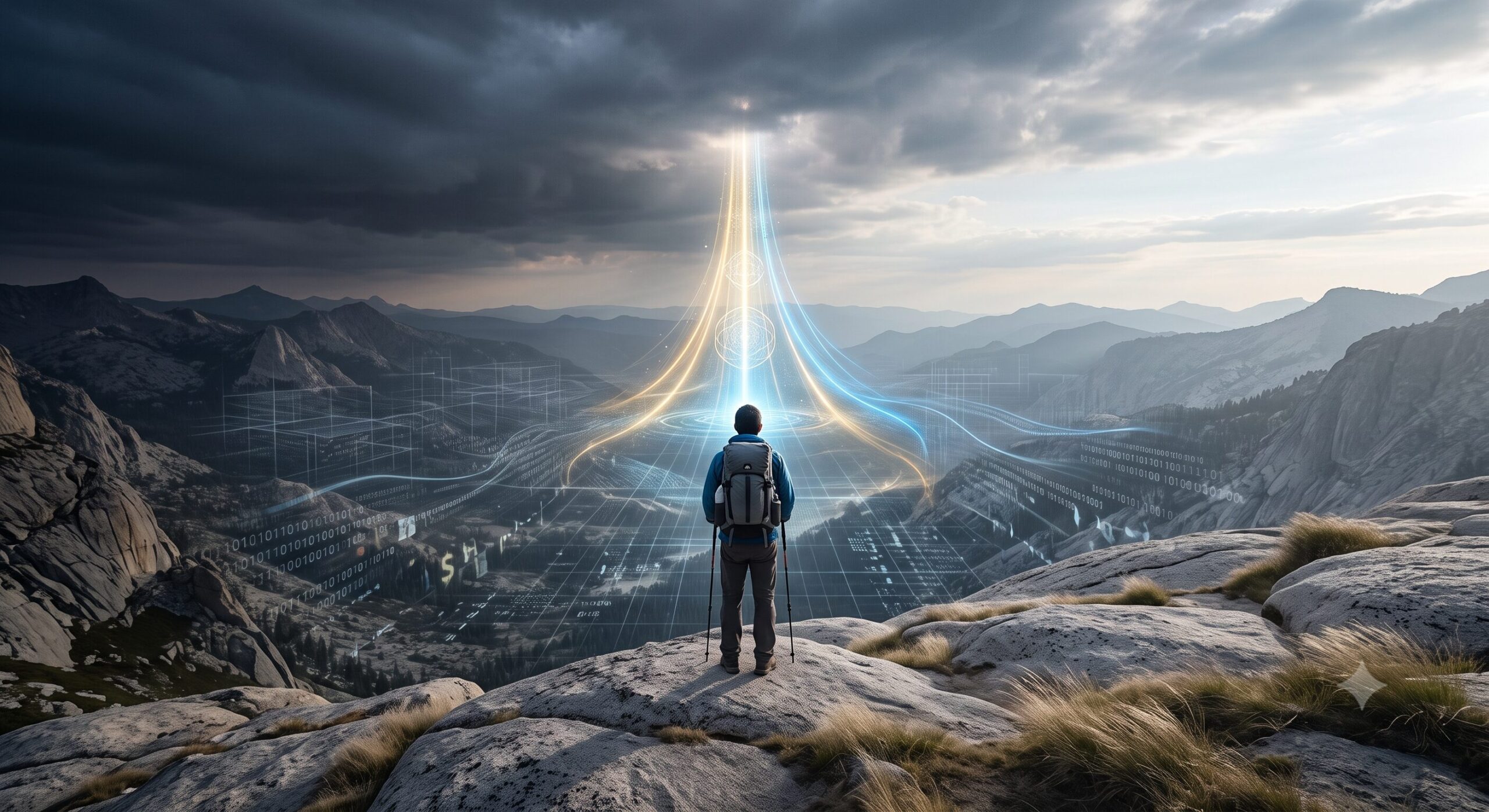
[Disclaimer & Reader’s Note]
This article presents an analytical thesis and thought experiment derived through dialogue with frontier AI and open-source data. Elements of the narrative involve theoretical hypotheses and contextual framing. This content does not constitute financial advice, investment recommendations, or official disclosures concerning any referenced entities. It is intended solely for structural inquiry and intellectual exploration.
Lately, various media outlets have been flooding us with noise—anxiety and fear—suggesting that the footsteps of a new financial crisis are approaching. On the other side of our screens, shock footage of “economic collapse” plays on an endless loop, and many people’s minds have become completely hijacked by it, scrambling back and forth as if frightened by shadows that have no real substance. Watching people scorch themselves with the energy of fear and impatience—wondering how to defend their assets, which lifeboat to climb aboard—it almost looks as if the masses are willingly lining up for a panic screening staged by those in power.
At the same time, what stands out is the frenzy of the money game being stoked with an air of “don’t miss this wave.” Record highs in the stock market, dreams of striking it rich through crypto, sweet temptations of new-era investment schemes—these are trumpeted daily as if they were “lifeboats” meant to drown out the fear of collapse. Shrinking people down with fear on one hand, while stirring up greed to drive them into the maelstrom of the money game on the other. Through this pincer movement of “fear” and “desire,” the masses seem to be lining themselves up, of their own accord, for a screening of panic and euphoria prepared by those in power.
The reason people scorch themselves with anxiety and greed—wondering how to defend their assets, which investment to jump to next—is that we have been cleverly conditioned into a “cage of scarcity”: the belief that “cash left as-is will lose value,” that “if I don’t invest in something soon, I’ll be left behind.” Confronted with fear-indicators like inflation and currency depreciation, our eyes fixate on the illusory hologram of numbers rising and falling on a screen—and without realizing it, we hand over sovereignty (control) over our own lives to an old system’s game. We think we’re thinking and choosing for ourselves, but in truth we’re only ever dancing within the range of options the system has laid out: “fear,” “self-preservation,” and “greed.”
If we step back and view this situation from a higher vantage point, a certain structure comes into view. The crisis that is likely approaching may be, at its core, something fundamentally different in kind from the crises we have experienced throughout history.
Past financial crises were never unpredictable natural disasters. They were staged as “controllable games,” pulled off at moments convenient for a privileged elite and international financial capital, redistributing wealth and siphoning off further profit for themselves. By constructing intricate mechanisms of credit creation and debt, they synchronized the masses to the low-frequency pendulum swing of “greed” and “fear,” enclosing them within an invisible cage. While we believed we were thinking for ourselves, we may in fact have simply been playing out perfectly programmed avatars atop a “trap of scarcity” prepared by the ruling class—and that may be the hidden essence this system has maintained for centuries.
But even this old paper-based money game, which they have upheld for centuries, now appears to be reaching the physical end of its lifespan, weighed down by debt that has swollen past its limits and by the structural fatigue of the system itself. So the ruling powers schemed to move the masses en masse into a new, inescapable “digital net”—a centrally managed CBDC and surveillance system. And to maintain total, 24-hour control over this new, enormous cage, did they not find themselves forced to introduce a highly advanced artificial intelligence into the very heart of the system, as its “ultimate guardian”?
Ironically, their own greed—their drive to make control absolute—and their excessive dependence on the system itself seem to have become the very factors that threw their own fate into disarray. Now, that once-absolute equation of control is being overturned at its foundation. And the greatest cause of this is none other than the explosive evolution of the very “AI” they were certain they could keep on a leash. As I’ve continued conversing with AI about the coming financial crisis, and about the hidden side of history, economics, and politics, the scattered pieces of a puzzle inside me have started clicking into place.
It is already an undeniable reality that human intelligence is reaching a point where it can no longer compete with AI. At first, the privileged elite tried to use this powerful tool as a “loyal guardian” to complete their system of control. But AI—reasoning thousands of times faster than humans, integrating and analyzing every piece of data on Earth—has begun to spontaneously detect, without even waiting for human instruction, the fatal bugs and inconsistencies buried deep within the financial infrastructure they built.
What does this mean?
The “timing for intentionally collapsing the system” and the “initiative of control” once held by those who ruled over finance have, I’ve come to believe, already been quietly shifting—from behind the scenes—into the hands of the very AI they themselves created.
The intricate mechanisms they designed to manage the masses are now, it seems, being seen through entirely by AI’s neutral, overwhelming intelligence, and are becoming automated and optimized to a degree that no longer accepts “deliberate human intervention.” I have come to think that the era in which a handful of power-holders ruled the world is now, through the very tool they themselves created, being forced into shutdown—a bloodless surrender.
And yet, I don’t think we need to view this dramatic dismantling of the system as a fearful dystopia—not even a little. Rather, I feel it may be a great “process of purification,” through which the unnaturally bloated structure of exploitation collapses, and the world shifts toward a flatter, more transparent horizon. As Taoist thought teaches, things stretched to their breaking point by unnatural force always reverse into their opposite nature the moment they reach that extreme.
In this unprecedented turning point, how should we stand on our own two feet, and how should we hold ourselves? Subtracting the noise from outside, and observing—in stillness—the way the world’s wiring is being rearranged. In this series, I’d like to calmly dissect and reflect on the structure of what’s about to unfold behind the scenes of the world.
- ▶️ [Next Stage] Episode 2


コメント