- 1. Ancient Wilderness and the Freedom of Self-Reliance — Memories of the Sierra Nevada and the Beginning of a Question
- 2. John Muir’s Concept of the “Temple” and the Historical and Scientific Development of LNT (Leave No Trace)
- 2-1. How John Muir Perceived the Wilderness — From an Object of Conquest to a “Sacred Temple”
- 2-2. From the Woodcraft Tradition to the Crisis of “Loved to Death”
- 2-3. The Limits of Regulation and the “Paradigm Shift Toward Education” — The Process of Institutionalizing LNT
- 2-4. Recreation Ecology and the Scientific Mechanism of the “Sigmoid Curve (Nonlinearity)”
- 2-5. The Seven Core Principles — A Framework for Acting in Harmony with Nature’s Logic
- 3. The Illusion of “Uninhabited Wilderness” and the Dualistic Limits of LNT
- 4. The Erasure of the Ego — Encountering “Hiker’s Legs” and the Purification of Spirit on the Mountain
- 5. Conclusion: Not Erasing Traces, But Becoming One with the Mountain
1. Ancient Wilderness and the Freedom of Self-Reliance — Memories of the Sierra Nevada and the Beginning of a Question
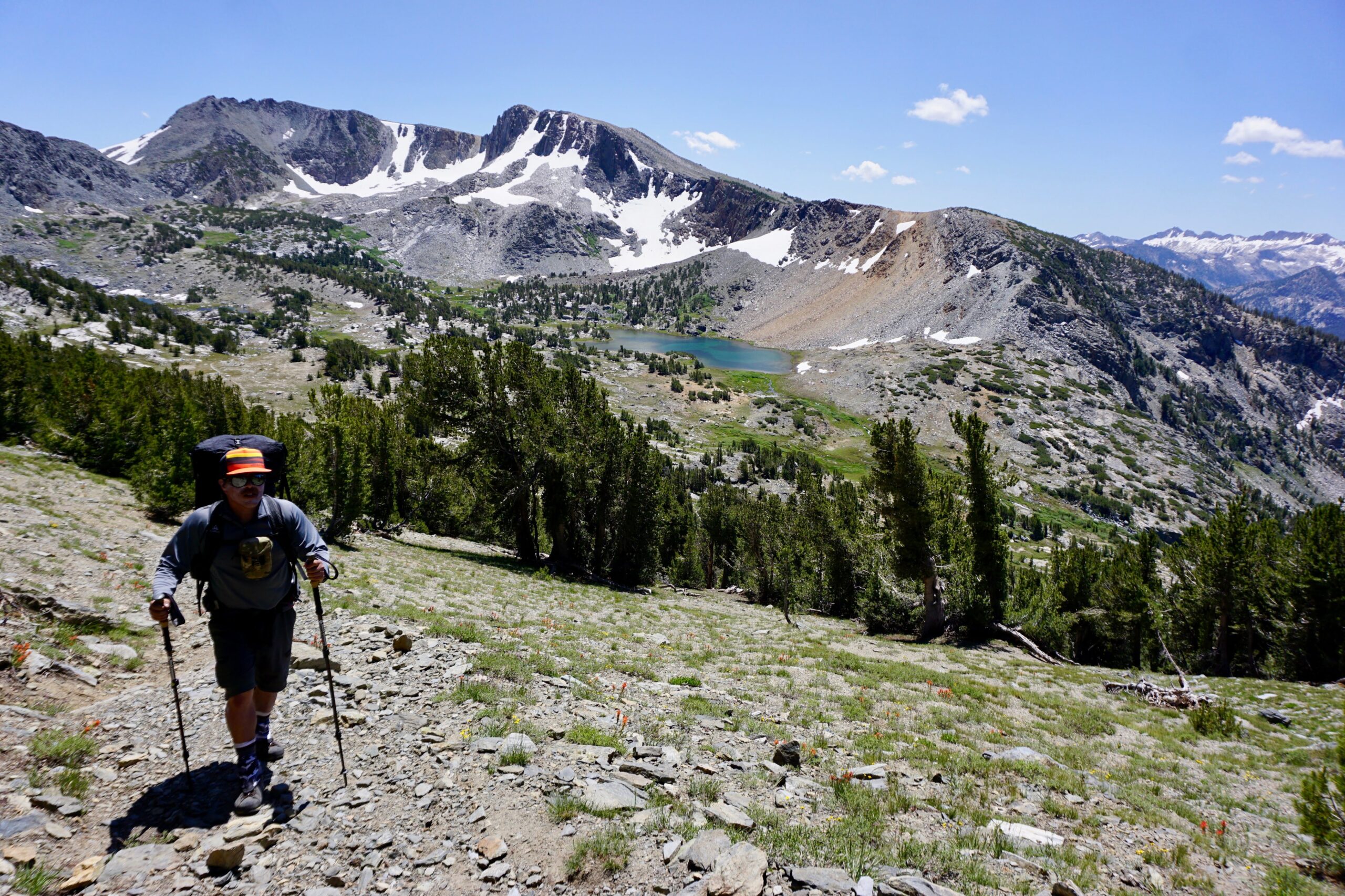
During the years I lived in the United States, I was fortunate to backpack repeatedly through the Sierra Nevada, including my 2019 thru-hike of the John Muir Trail (JMT) in its entirety. The majestic Yosemite Valley, the tranquil glacial lakes of the Ansel Adams Wilderness, the sacred groves of Sequoia and Kings Canyon—these areas I passed through on the JMT still glow with a particular brilliance in my memory. Along the route the JMT traces, and in the surrounding mountain regions, modern lodges, shops, and artificial comforts are almost entirely absent. The moment one steps deeper into the trail, there is only an overwhelming wilderness, vast and silent, preserving its primeval form exactly as it has always been.
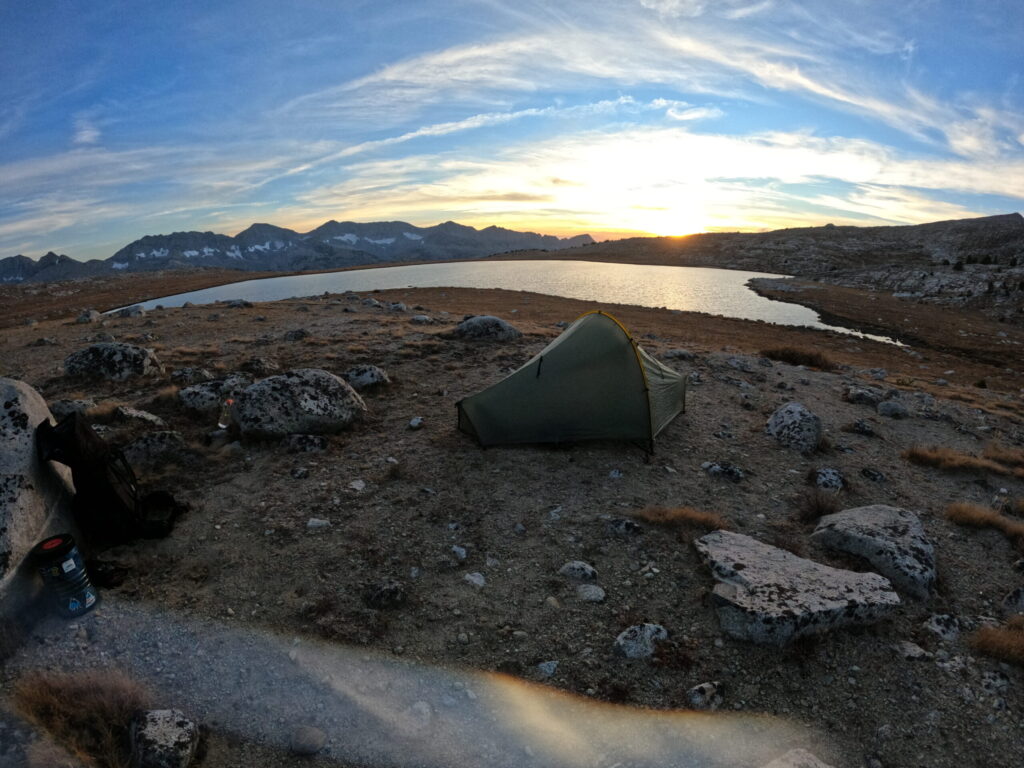
Backcountry camping in the Sierra is, in principle, left to the hiker’s own discretion—but that freedom rests on a foundation of strictly enforced rules. Depending on the area, for instance, there are ecological protections such as bans on open fires above 9,000 feet in elevation, or requirements to camp at least 200 feet from water sources. The boundaries of no-camping zones are also managed with great precision. The first time I set foot in the Sierra wilderness, I felt in my own body—through this freedom to camp, built upon rules and self-reliance—both the open-minded tolerance unique to the American West and the boundless scale of nature itself.
Even in the shoulder season before winter sets in, there were moments when my water bottles froze solid, and passes above 13,000 feet (3,963 meters) to cross. Heading out into the Sierra for several days of backpacking could, quite literally, feel like an act of “wearing away at one’s own life.” And yet, in the midst of this grueling trek, a question kept surfacing again and again in my mind: Why is it that hikers are drawn to this vast wilderness—and why have we come to be taught to leave it without a trace?
2. John Muir’s Concept of the “Temple” and the Historical and Scientific Development of LNT (Leave No Trace)
2-1. How John Muir Perceived the Wilderness — From an Object of Conquest to a “Sacred Temple”
John Muir, the naturalist for whom the JMT is named, called the Sierra Nevada mountains a “Sacred Sanctuary” or the “Range of Light.” In the late 19th century, against an American society that was developing and consuming nature as a resource amid industrialization and westward expansion, Muir redefined the wilderness as a “sacred church that redeems the human spirit.”
Yet from Muir’s era through the mid-20th century, the logic of American outdoor recreation was governed by an entirely different philosophy—the tradition of “Woodcraft.”
2-2. From the Woodcraft Tradition to the Crisis of “Loved to Death”
Under the Woodcraft philosophy that prevailed through the first half of the 20th century, rooted in the frontier spirit, it was a point of pride to cut down live local trees to build log cabins and shelters, fashion beds from branches and leaves, and build large campfires using local firewood. The skill of overcoming nature through one’s own strength and living off the land was celebrated as a symbol of self-reliant masculinity. However, this approach was only sustainable given an extremely low population density—one that did not exceed the natural environment’s capacity for recovery.
Between the 1950s and 1970s, innovative gear emerged and spread rapidly: lightweight nylon tents, synthetic sleeping bags, aluminum-frame backpacks, and portable camp stoves. As the barriers to outdoor recreation dropped dramatically, public visits to national parks and forests surged explosively. According to statistics from the National Park Service (NPS), park visitor numbers jumped more than fivefold, from 33 million in 1950 to 172 million in 1970.
This explosive boom dealt a devastating blow to the natural environment. Soil erosion from trampled vegetation, behavioral changes in wildlife due to feeding, the unchecked spread of campsites, and scattered trash all became widespread problems. Among land managers and conservationists, a strong sense of crisis took hold: the wilderness was being “loved to death.”
2-3. The Limits of Regulation and the “Paradigm Shift Toward Education” — The Process of Institutionalizing LNT
Initially, federal land management agencies such as the U.S. Forest Service (USFS) and the National Park Service (NPS) attempted to address this crisis through top-down administrative regulation—visitor quotas, bans on use in certain areas, and mandatory permit systems. While the 1964 Wilderness Act advanced the designation of protected wilderness areas, excessive government control and penalties bred conflict and deep resentment among hikers who came to the wilderness seeking freedom and self-determination.
A shift was needed—from “coercive control” to “voluntary behavioral change through education.” Land management agencies were forced into a major strategic pivot. From the late 1970s onward, educational campaigns such as “wilderness manners” and “low-impact camping” spread across the country, and private educational organizations—including the National Outdoor Leadership School (NOLS), founded by Paul Petzoldt in 1965—also began developing minimum-impact techniques.
Following a historic meeting held in the Popo Agie Wilderness in 1985, federal agencies published the booklet Leave No Trace Land Ethics in 1987, and “Leave No Trace” was adopted as the official shared language. Then, in 1994, the independent nonprofit Leave No Trace Center for Outdoor Ethics (now the Leave No Trace Organization) was formally established, consolidating a nationwide educational and research program through public-private partnership.
2-4. Recreation Ecology and the Scientific Mechanism of the “Sigmoid Curve (Nonlinearity)”
The behavioral principles of LNT are not mere moralizing or abstract ethical rules—they are grounded in the scientific findings of the academic field known as Recreational Ecology.
Among the most important scientific insights, clarified through research by David Cole and others, is the “nonlinearity” of environmental impact caused by human activity—often described as a sigmoid curve, or S-curve relationship.
The impact of trampling on vegetation and soil tends to progress sharply during the very earliest stages of use—when only a handful to a few dozen people have walked through an area—with the majority of the damage occurring at that point. After that, no matter how much use increases, the rate of further damage slows and eventually reaches a kind of saturation point.
Based on this ecological mechanism, LNT presents a clear, two-pronged strategy of use: “Concentrate” and “Disperse.”
In popular, heavily used areas: Since the limit of damage predicted by the S-curve has already been reached, use should be “concentrated” in specific locations. By having everyone walk the same trail and use established, designated campsites, the further expansion of damaged areas is minimized.
In pristine areas (largely untouched by human use): To avoid crossing the steep damage threshold that occurs in the earliest stages of trampling, hiking routes and tent sites should be varied each time to “disperse” impact. This helps prevent any single location from sustaining irreversible damage and becoming a new site of lasting impact.
2-5. The Seven Core Principles — A Framework for Acting in Harmony with Nature’s Logic
The LNT Center has systematized this body of scientifically grounded outdoor knowledge and distilled it into the “Seven Principles”—simple enough for ordinary visitors to intuitively apply in the field.
- Be Considerate of Other Visitors: Maintain a high-quality wilderness experience for everyone by sharing quiet and yielding courteously on the trail.
- Plan Ahead and Prepare: Research weather conditions and regulations in advance to prevent emergencies and unnecessary impact.
- Travel and Camp on Durable Surfaces: Choose durable surfaces such as rock or gravel at least 60 meters from water sources, to help protect shorelines and waterways.
- Dispose of Waste Properly: Follow the principle of “Pack it in, pack it out,” and bury human waste in a shallow cathole 15–20 cm deep, at least 60 meters from water sources and trails.
- Leave What You Find: Preserve plants, rocks, and cultural artifacts to maintain the historical and biological integrity of the landscape.
- Minimize Campfire Impacts: Prioritize the use of a camp stove over an open fire, to prevent the burning of organic matter in the soil and the disruption of nutrient cycling from dead wood.
- Respect Wildlife: Maintain a safe distance and strictly avoid feeding animals, to prevent changes in their natural behavior and reduce the risk of conflict.
In the backcountry of the Sierra Nevada—including areas like Yosemite and Kings Canyon—many stretches have no designated campsites, leaving hikers free to choose their own spot to camp. Even so, as a matter of LNT practice, the golden rule is to seek out ground that already bears traces of past use whenever possible. Hikers are further expected to identify bare soil rather than grass-covered ground, so as not to damage precious meadow vegetation, when pitching a te—
(The source text appears to be cut off mid-sentence at the end. Let me know if you’d like me to complete this once you have the remainder of the passage.)
3. The Illusion of “Uninhabited Wilderness” and the Dualistic Limits of LNT
And yet, even this admirable code of outdoor ethics—LNT—faces serious critique from the perspectives of contemporary environmental history and critical geography.
First, as environmental historian James Morton Turner has argued, LNT is deeply entangled with a form of “high-consumption environmentalism.” The practice of non-intervention—”don’t cut local wood, don’t build fires, don’t dig into the ground”—presupposes the purchase and consumption of highly advanced outdoor gear: gas stoves, synthetic-fiber tents, ultralight Dyneema packs, and the like. Hikers gain a sense of moral superiority as “eco-conscious consumers who leave no trace,” while a deeper structural problem goes unexamined: the greenhouse gas emissions and industrial waste generated on a global scale through the manufacturing and distribution of that gear, and the fact that such production is sometimes carried out through forced or exploited labor.
Second, there is the historical illusion of “Unpeopled Wilderness.” The ideal that LNT and the 1964 Wilderness Act both take for granted—a “pure, primeval nature untouched by human hands”—is, in fact, nothing more than a narrative shaped by the perspective of white settlers. Native American peoples have inhabited the ecosystems of the North American continent for thousands of years, sustaining an inseparable, interactive relationship with the land through practices such as intentional controlled burning and sustainable gathering.
Because LNT rests on an absolute binary opposition—”humans” versus “the nature that humans destroy”—it cannot escape the charge that it has, in effect, erased and rendered invisible the long history of Indigenous land stewardship and the cultural rights that accompany it.
4. The Erasure of the Ego — Encountering “Hiker’s Legs” and the Purification of Spirit on the Mountain
And yet, the inner transformation we experience on the trail is filled with a reality that goes beyond such theoretical critique.
Partway through my journey on the John Muir Trail, there were days when exhaustion built up and a deep sense of loneliness set in. The mountains become a mirror that reflects “oneself” back with almost frightening clarity. I had thought I was escaping into the backcountry, shedding all the trappings of the secular world—only to discover that, tucked at the bottom of my pack, my own petty pride, anxieties, and insecurities had come along with me, fully intact.
But as I repeated the ordeal of crossing one grueling pass after another, something curious began to happen. In perfect sync with the process of my food supply dwindling and fitting more and more neatly into the bear canister, the excess pride and mental noise inside me were also being stripped away, piece by piece.
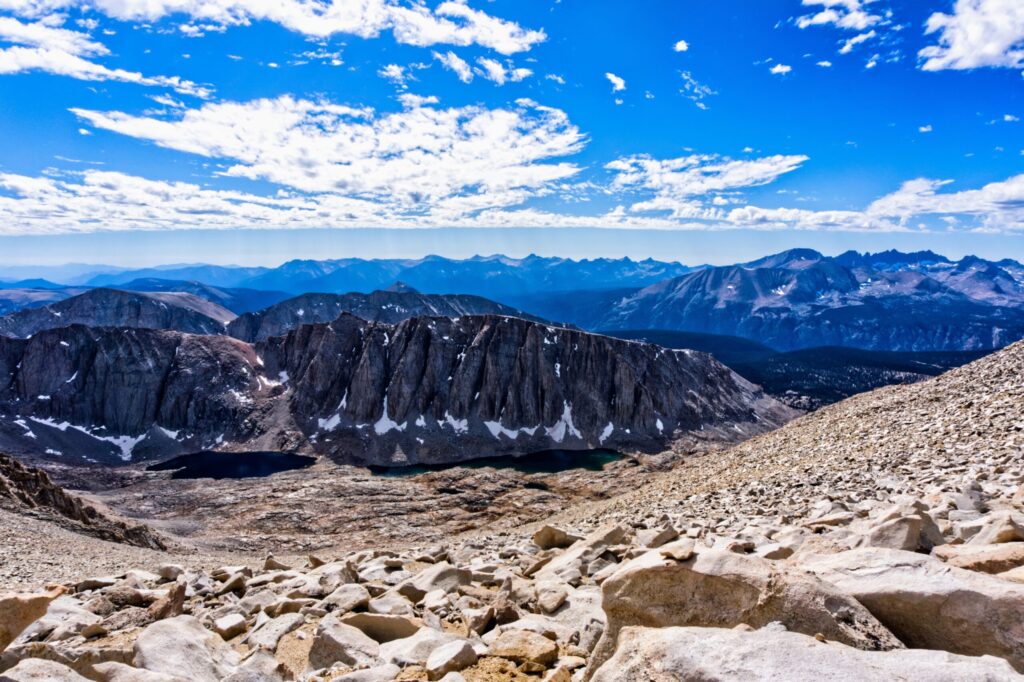
By the time I crossed through the heart of Kings Canyon—Muir Pass, then Forester Pass (13,200 ft / 4,009 m)—I had passed beyond the limits of my physical body and arrived at a kind of “hiker’s high,” a purification of spirit.
On the final day, during the summit push toward Mount Whitney (14,505 ft / 4,421 m), the highest peak on the trail, I depoted my large pack and set off with nothing but a small summit sack—and in that instant, a strange sensation shot through my body. My legs, which had carried me over 200 miles and should have been utterly spent, had instead metamorphosed into what hikers call “hiker’s legs”—fully adapted to the mountain trail. The moment the weight vanished from my back, my body felt so light I might have taken flight, and all that remained was a pure forward momentum, as if I had simply become part of the mountain itself.
5. Conclusion: Not Erasing Traces, But Becoming One with the Mountain
The true value of Leave No Trace (LNT), I believe, is not merely a movement to “pack out your trash” or an act of obedience to a set of rules.
Rather than compelling behavior through administrative penalties or warnings—an authority imposed from outside—its purpose lies in quietly contemplating the objective physical and ecological laws inherent in the natural world itself, and thereby awakening one’s own intrinsic sense of ethics.
The spirit underlying the practice of “leaving no trace” is not about separating humans from nature. It is a discipline of quieting the assertions of one’s isolated “ego,” and gently dissolving oneself into the waves and cycles of the natural world.
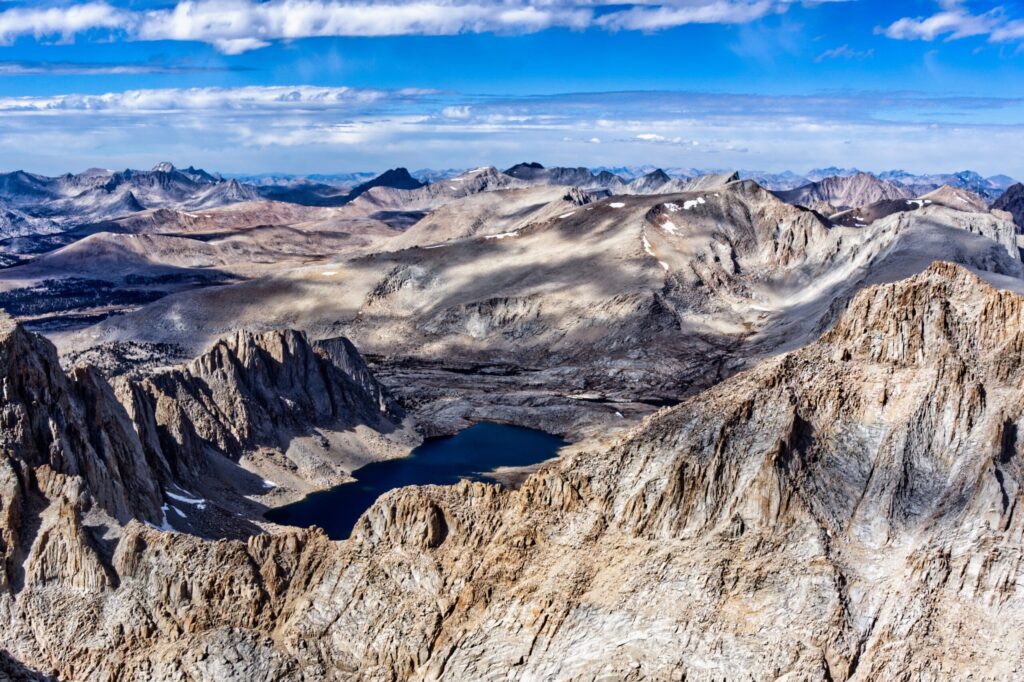
Gazing upon the vast mountain range the JMT traces, from Yosemite through Sequoia and Kings Canyon—a landscape so magnificent it almost feels illusory—I found myself thinking deeply about John Muir, the “father of American conservation.” As he traversed this land, which once lay entirely in its primeval state, and came to recognize its true worth, how much awe and reverence must have filled his heart? Listening to the sound of the Sierra wind, I found myself reliving, in my own body, something of the overwhelming reverence he must once have felt.
When I finally stood atop Mount Whitney, at the 214-mile terminus of the trail, what awaited me was not a joyous celebration, but an overwhelming sense of solitude and relief. And yet, in that supreme moment of achievement—savored quietly, all alone—I felt the boundary separating myself from nature dissolve entirely.
Humans must never again become outside invaders or conquerors who bring destruction to nature. Instead, we must become stewards—showing reverence for the land, making our own presence as unobtrusive as possible, and living as one with its deep and abiding energy.
Reference & Further Reading+
- LNT History & Official Guidelines (歴史と公式ガイドライン)
- Hampton, B., & Cole, D. (1988). Soft Paths: How to Enjoy the Wilderness Without Harming It. Stackpole Books / National Outdoor Leadership School (NOLS).
- Notes: The foundational book that codified low-impact camping practices and helped establish the Leave No Trace ethic.
- Leave No Trace Center for Outdoor Ethics. The 7 Principles of Leave No Trace. LNT.org.
- Notes: The official framework for outdoor ethics, scientific education, and environmental stewardship.
- Marion, J. L. (2014). Leave No Trace in the Outdoors. Stackpole Books.
- Notes: Comprehensive guide detailing the science and practical application of Leave No Trace principles in backcountry settings.
- Recreation Ecology & Environmental Science (レクリエーション生態学)
- Cole, D. N. (2004). Impacts of Hiking and Camping on Soils and Vegetation: A Review. Outdoor Recreation Impacts: Environmental Assessment and Management.
- Notes: Fundamental research explaining the non-linear “Sigmoid Curve” relationship between visitor use and environmental impact.
- Cole, D. N. (1995). Experimental trampling of vegetation: Standardized procedures for hiking studies. Journal of Applied Ecology, 32(1), 203-214.
- Notes: Scientific foundation for the “Concentrate vs. Disperse” land use strategies in backcountry management.
- Liddle, M. (1997). Recreation Ecology: The Ecological Impact of Outdoor Recreation and Ecotourism. Chapman & Hall.
- Notes: A seminal textbook exploring human impacts on wilderness ecosystems.
- Critical Perspectives: Consumerism & Indigenous Stewardship (批判的考察:消費主義と先住民)
- Turner, J. M. (2002). From Woodcraft to ‘Leave No Trace’: Wilderness, Consumerism, and Environmentalism in Twentieth-Century America. Environmental History, 7(3), 462–484.
- Notes: A key historical critique examining how LNT shifted outdoor culture from self-reliant woodcraft to gear-dependent consumerism.
- Cronon, W. (1995). The Trouble with Wilderness: Or, Getting Back to the Wrong Nature. Environmental History, 1(1), 7-28.
- Notes: A groundbreaking essay deconstructing the myth of “untouched, unpeopled wilderness” in Western environmental thought.
- Spence, M. D. (1999). Dispossessing the Wilderness: Indian Removal and the Making of the National Parks. Oxford University Press.
- Notes: Historical analysis of how Indigenous peoples were forcibly removed to create “pristine” National Parks like Yosemite and Yellowstone.
- Communication & Wilderness Management (心理学とコミュニケーショ手法)
- Wallace, G. N. (1990). Law Enforcement and the “Authority of the Resource” Technique. Ranger: The Journal of the Association of National Park Rangers, 6(2), 4-6.
- Notes: Introduces the “Authority of the Resource Technique” (ART) to foster intrinsic ethics rather than top-down agency enforcement.



コメント