
Introduction — My First Overnight Camp After Returning to Japan
This trip took place in late May, right when the fresh green leaves were beginning to deepen.
For the first time in a long while, I packed my full overnight gear into my backpack and headed toward Mizugaki Mountain.
It would become my first tent night in Japan since returning from the United States.
I had never stayed in a Japanese mountain hut before, but tent camping must be done at a designated site—usually next to a hut—so I made a simple plan:
two nights at Fujimidaira Campsite, and a summit of Mizugaki in between.
Mt. Mizugaki — A Maze of Granite Towers and a Mountain of Ancient Faith
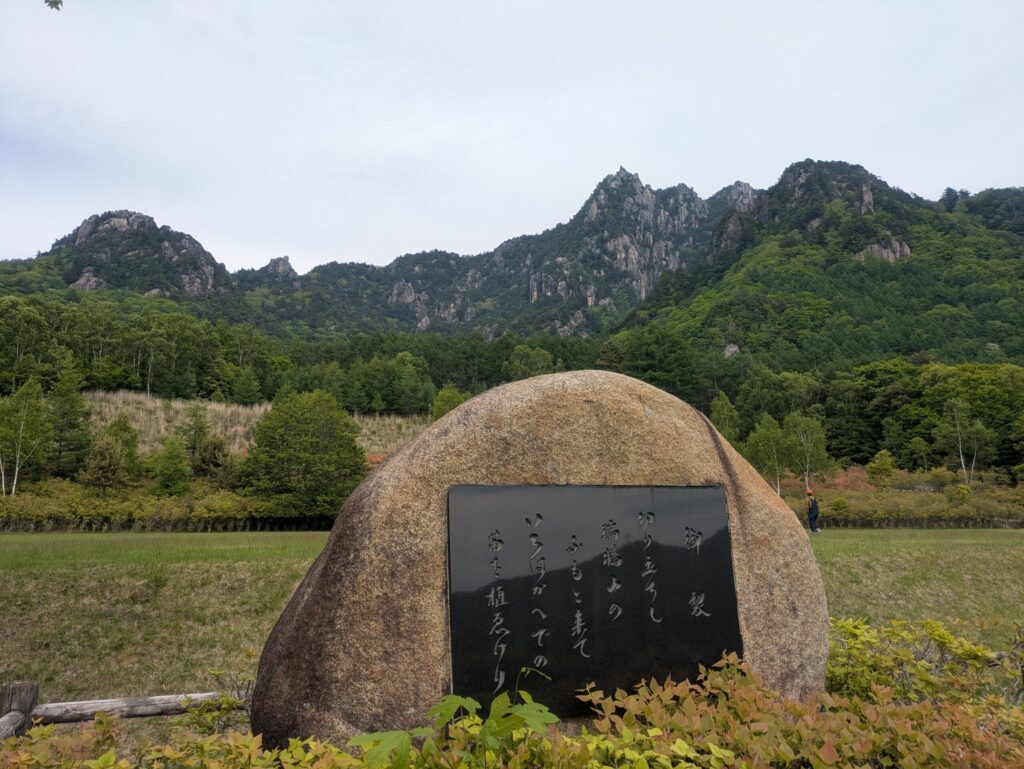
Mizugaki-yama (2,230m) is a granite peak located on the western edge of the Okuchichibu range.
Together with Mount Kinpu, its rugged silhouette is clearly visible even from the Kofu Basin.
If Mount Kinpu is defined by the sacred monolith Gojoiwa that sits atop its summit,
then Mizugaki-yama feels like an entire “temple of rock.”
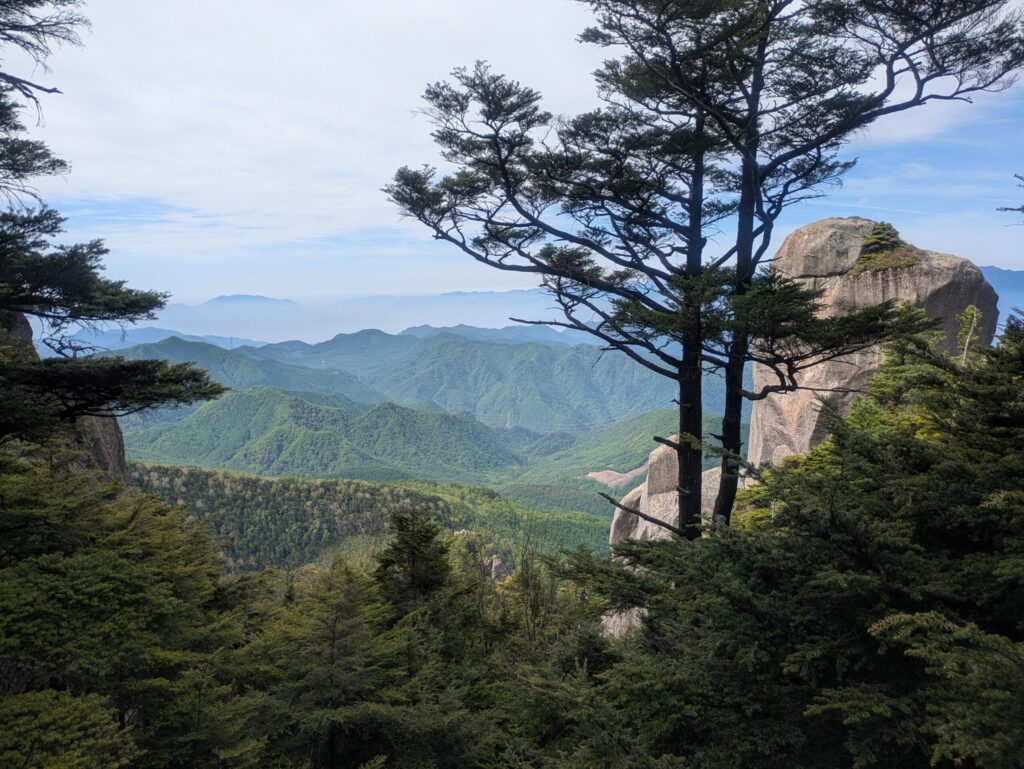
From its mid-slopes all the way to the summit, bizarrely shaped granite spires and massive boulders stand like watchful guardians.
No matter how far you climb, the landscape is nothing but rock, rock, and more rock.
A bit of research reveals that Mizugaki-yama, too, has long been regarded as a sacred mountain.
Practitioners of Shugendō once used both Mizugaki-yama and Mount Kinpu as places of ascetic training,
and people of the Kofu Basin worshipped the mountain from afar.
Such traditions are common across Japan’s mountains—but in Mizugaki-yama’s case, the sense of “the rock itself as a deity” feels especially strong.
For someone like me—who spent years backpacking in the vast mountain ranges of North America—
encountering a mountain steeped in ancient spiritual traditions feels both refreshing and strangely nostalgic.
It evokes a quiet, almost mysterious familiarity, as if I’ve returned to a place I somehow remember.
Day 1: To Fujimidaira
Into the Quiet Forest from Mizugakisan Lodge**
My journey began at Mizugakisan Lodge.
Late May meant that the fresh green of early spring had deepened into a lush, saturated forest—leaves darkening into the rich colors of early summer.
My pack carried a full set of overnight gear for the first time since last October,
when I had spent a week backpacking in the Sierra Nevada.
But on this route, the distance to Fujimidaira Hut was short—less than an hour even at a slow pace.
This meant that the trip would feel more like a relaxed day hike than a full backpacking expedition.
It also seemed like the perfect gentle outing for rehabbing my shoulder (diagnosed with a torn rotator cuff) and my lower back, which had been troubled by spondylolisthesis.
The weight itself wasn’t surprising, but as soon as I started walking, that familiar sensation returned:
“Ah… this feeling.”
A wave of nostalgia washed over me—
the rhythm of hiking with a loaded pack,
the quiet focus,
the subtle thrill in each step.
It was as if my body remembered before my mind did.
Restarting My Backpacking Life in Japan
Walking steadily through the forest,
I soon arrived at Fujimidaira Hut.
A simple mountain hut with a campground, toilets, and a small water source.
Since it was a weekday, the area was nearly empty—only about seven tents in sight.
Choosing a campsite, lowering my pack,
hammering the stakes, raising the poles—
A tent is not merely an overnight shelter.
It’s a switch that shifts your entire mode of being.
The hut itself sits quietly in ordinary forest,
but on crowded weekends nearly a hundred tents can fill this place.
I had seen the chaos of Japanese huts on YouTube or in magazines,
yet having spent years camping only in the silent wilderness of the Sierra and Rockies,
the “culture of mountain huts” felt strangely new.
For a brief moment, memories overlapped—
the icy air on a lakeshore campsite in the Sierra,
the night I tucked my tent behind a boulder to escape Rocky Mountain winds,
the countless tents I pitched along the John Muir Trail.
And then,
a quiet realization:
I’m finally in the mountains of Japan.
That evening, I wandered the nearby trails, then settled into camp.
Boiled water.
Drank coffee.
Nibbling on snacks, I pictured tomorrow’s ascent of Mt. Mizugaki.
Since I planned two nights here despite a short route,
I even brought a small flask of whisky—
something unheard of on my longer, ultralight backpacking trips in the States.
It had been a long time since I camped like this—slowly, deliberately.
And it felt good.
Day 2: Through the Corridor of Giant Rocks to the Summit of Mount Mizugaki
From Forest Trails Into a World of Stone
The next morning, I stepped out of my tent while the air was still slightly cold and began heading toward the summit with a light pack.
From Fujimidaira, the trail first descends toward a stream, then climbs back up toward Mount Mizugaki.
It begins as a quiet walk through the forest. But as the elevation increases, more and more boulders appear underfoot, and strange, uniquely shaped rock towers begin to emerge in the distance.
The gradual transformation from a “mountain of forests” into a “mountain of rocks” makes the trail increasingly fun to walk. Before I knew it, my eyes were no longer focused on the path at my feet—
they were drawn to the sheer rock walls rising on both sides, and to the massive boulders scattered across the landscape.
The Great Yasuri Rock—and That Moment of Wordless Awe
Soon, the towering formations come into sight, including the iconic Ō-Yasuri Rock.
Even hikers who had been chatting casually until then grew silent and focused as they reached this section.
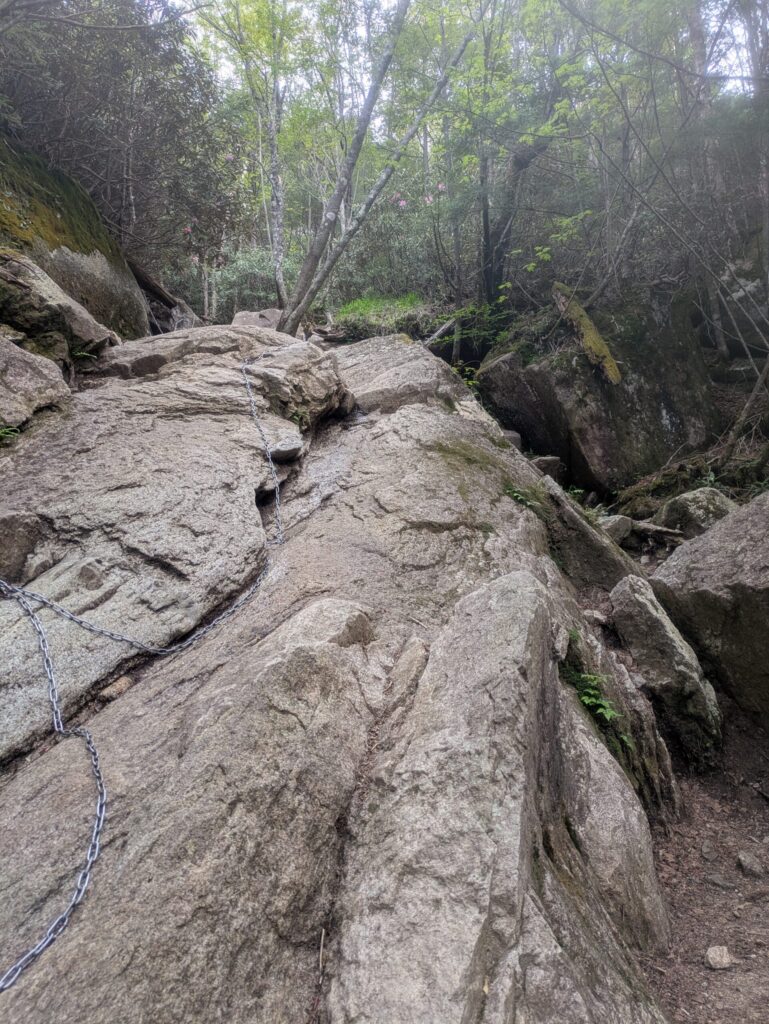
Chain sections like this were something I had never encountered on American trails, so the experience felt fresh and exciting. The technical difficulty here is said to be modest, and indeed, I passed through without any trouble.
As I stood before these colossal rocks, a sudden thought struck me:
“Ah… this truly is a sacred mountain.”
It felt completely natural to imagine ancient practitioners of Shugendō standing before these very stones, offering prayers to something far beyond themselves.
The Final Rock Scrambles and a Summit That Feels Like an Altar
As the trail nears the summit, the rocky sections and chains increase.
It isn’t particularly dangerous, but every step requires attention—checking each foothold before moving upward.
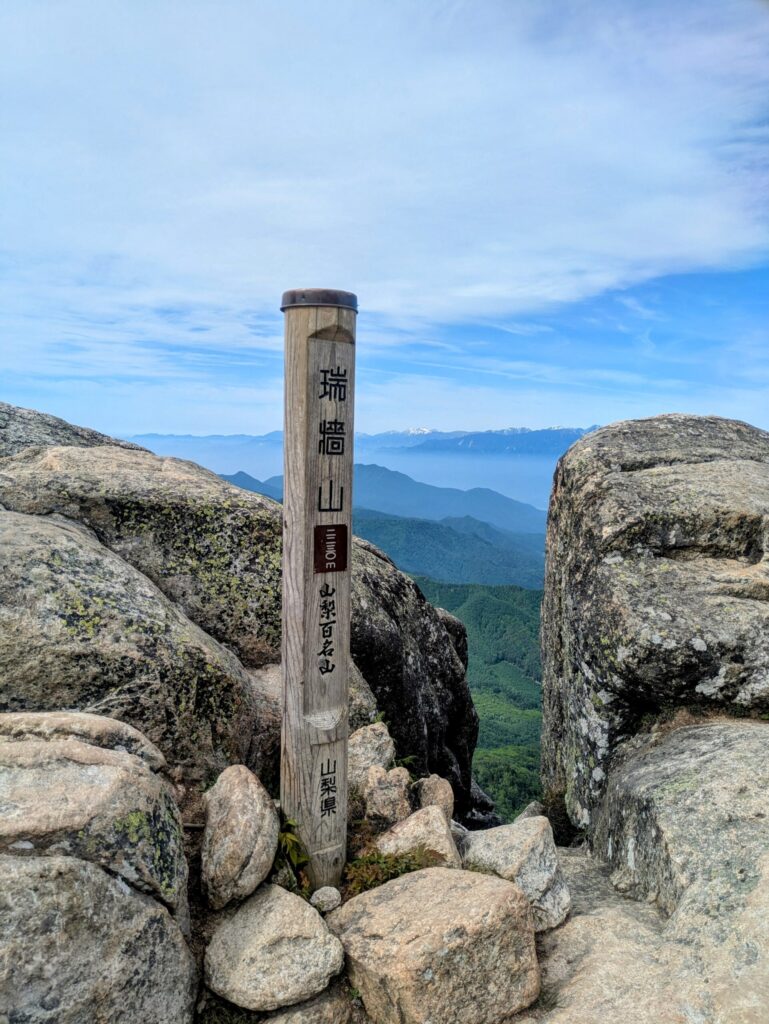
Just as I climbed over the final rock, the view burst open all at once.
That was the summit of Mt. Mizugaki.
Standing there, the sheer presence of the peak left me speechless.
There is a unique, compact intensity to the Japanese mountains—a sense of sacred compression—that is impossible to feel in the vast American ranges.
Each massive granite tower felt like a shrine or deity in its own right,
and simply being there made my posture naturally straighten.
Turning back toward Mt. Kinpu, I could see the ridge crowned with the sacred Gojo-iwa boulder.
To the south stretched the Southern Alps; on the opposite side, the Yatsugatake Range.
And far beyond them, the faint outline of Mt. Fuji.
As I slowly spun in a full circle,
it felt as though the surrounding mountains were standing in formation around a single altar—this summit.
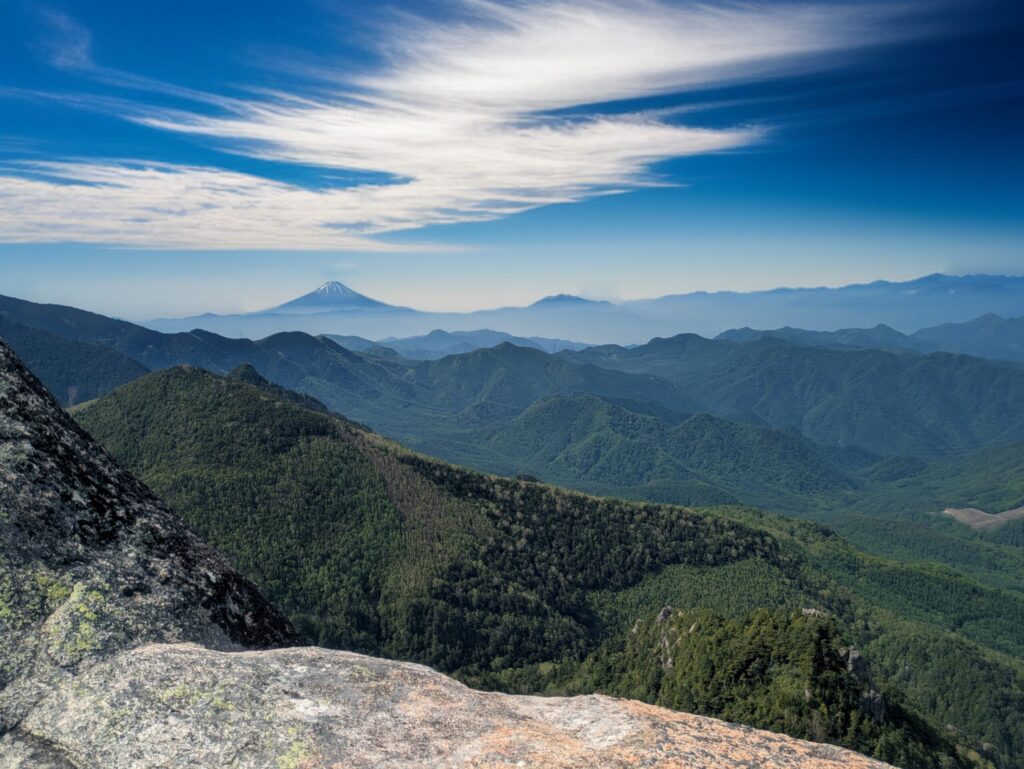
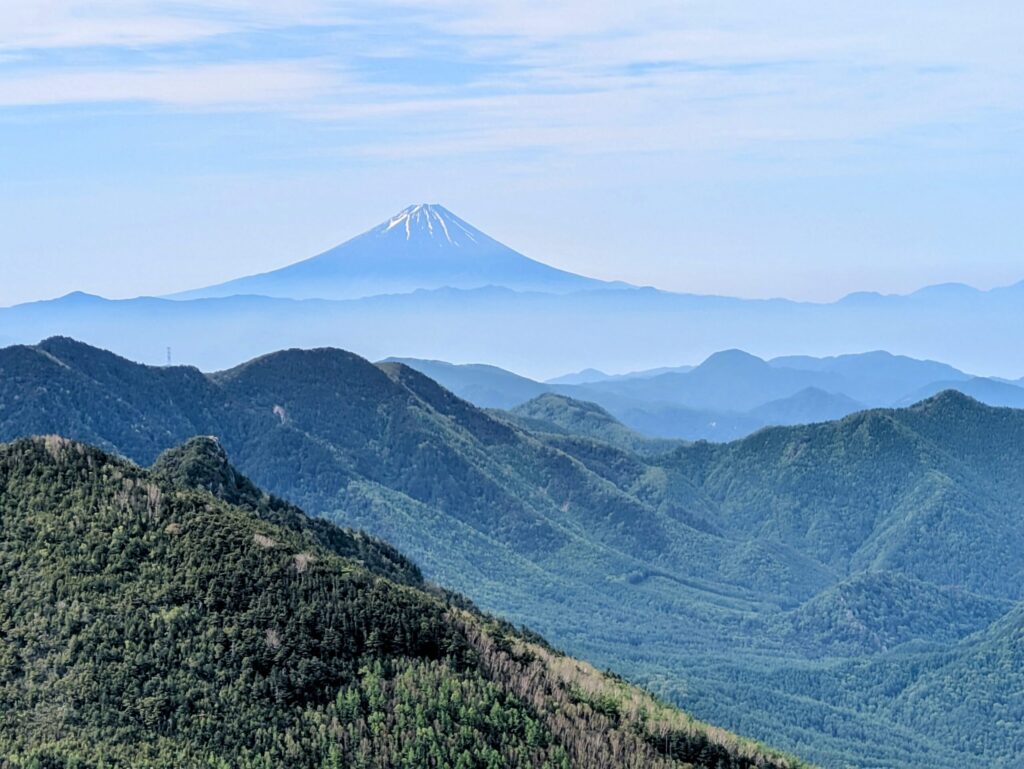
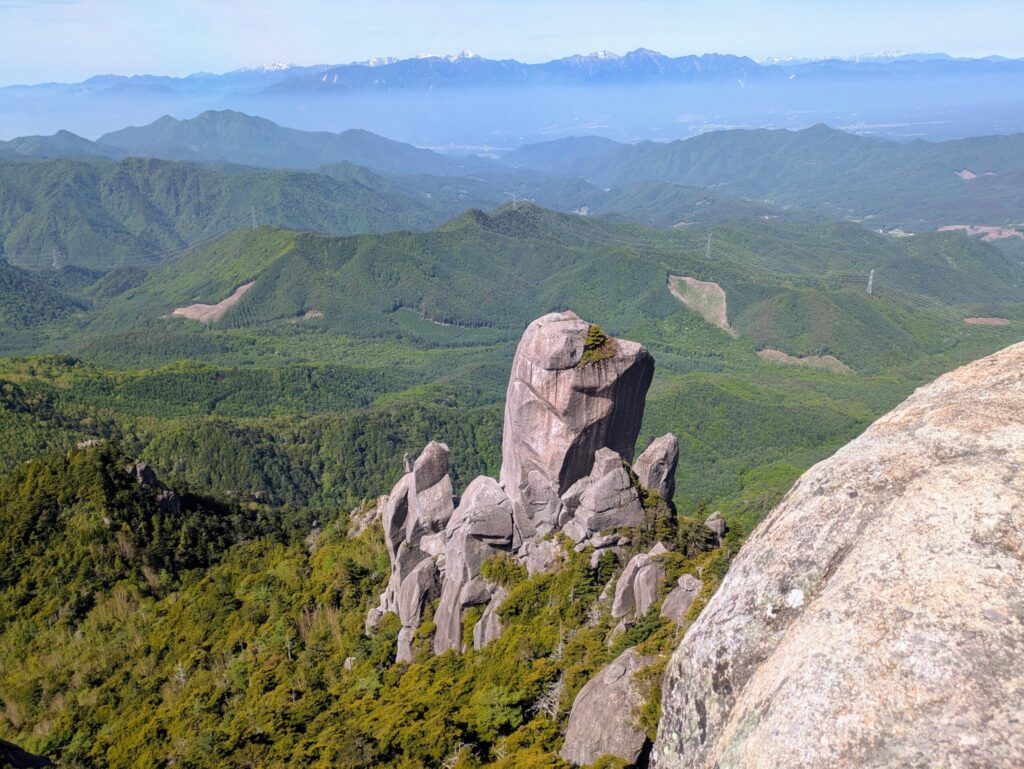
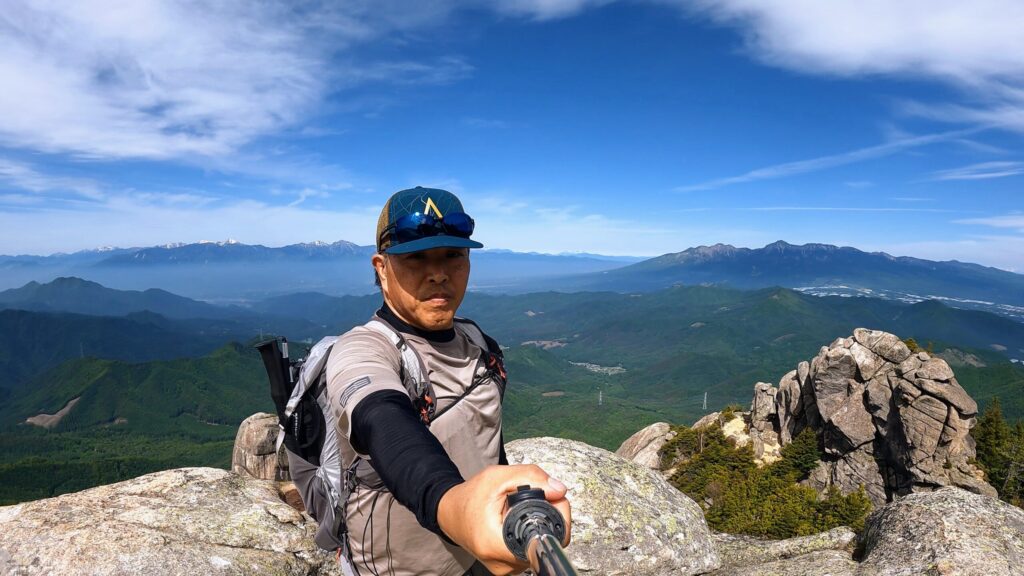
Looking down from the summit, all I could see was an endless expanse of dense, dark green forest.
For someone like me—who had spent years hiking the dry, high-elevation ranges of the Sierra and the Rockies—this sight felt strikingly fresh.
Japan’s mountains are hot and humid compared to North America’s arid ranges.
Because of that, the vegetation is lush, vibrant, and alive in a way I wasn’t used to.
Standing there, surrounded by this deep, breathing green, I finally felt I understood one of the distinct beauties of Japan’s mountains.
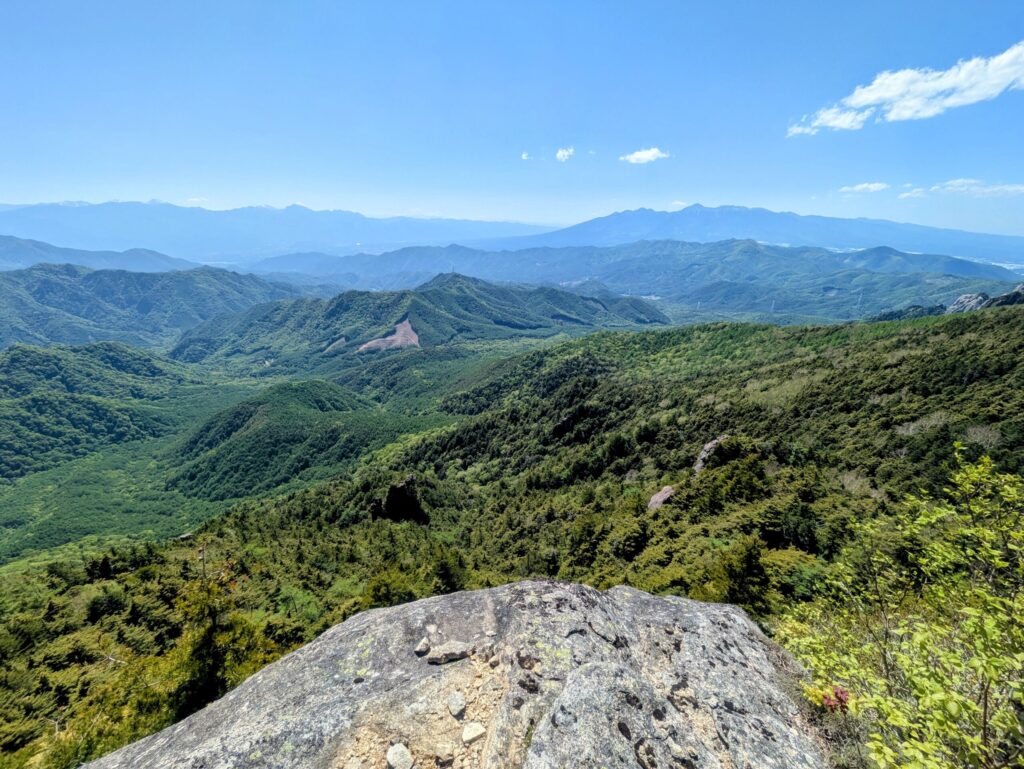
How I Receive a Sacred Mountain Today
Mizugaki-yama carries the context of being a sacred mountain.
But as a modern-day hiker, I’m not performing any particular religious rituals there.
Even so, while walking in the mountains,
there are moments when I naturally feel like bowing my head.
This was something I had often sensed even back when I was backpacking in the U.S.
All those countless beautiful places in the national parks felt like power spots.
At Mizugaki-yama as well—
when I stood still before O-yasuri Rock,
when I gasped at the view from the summit,
when I sat in the quiet evening light at the campsite—
I could feel a sacred atmosphere in this mountain area.
Each of those moments may not be so different from the feelings ancient people had when they placed their hands together and prayed toward the mountains.
I felt intuitively that this place, too, is undoubtedly a vortex—a power spot that ancient people must have perceived in a similar way.
If even I, dulled by modern conveniences and technology, can sense it to some degree, then the spiritual sensitivity of mountain ascetics like the yamabushi must have been incredibly strong.
In any case, this land radiates a deep sense of sanctity.
At the very least—
the gentleness with which we touch the rocks,
refraining from shouting,
not leaving trash behind—
perhaps all of these are the modern forms of paying respect at a sacred site.
Packing Up the Tent and Returning to Daily Life — Something Finally Shifted
After descending from the summit back to Fujimidaira, I returned to my campsite.
I boiled water in the tent vestibule, sipped my coffee, and quietly reflected on the climb.
Mizugaki-yama is a popular peak, and despite being a weekday, there were many hikers and plenty of activity.
The distance itself is short, but with a number of sections requiring three-point contact and rock scrambling, it offered a solid challenge—especially since I hadn’t hiked much earlier in the year.
The steep rocky climbs and chain-assisted sections were genuinely enjoyable.
When I packed up my tent, hoisted my backpack again, and began the descent,
I realized that—even though this was a relatively easy overnight trip—
something inside me had quietly switched on:
“All right… I will be backpacking in Japan too.”

コメント